
Home
Philip. M. Taylor 1954-2010
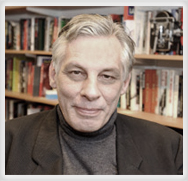
Philip. M. Taylor, the first Professor of International Communications in the UK, one of the field's outstanding scholars and a founding member of the Institute of Communication Studies (School of Media and Communication), died in December 2010.
An historian by training and instinct Phil, as he was known, developed an interest in contemporary strategic communications. He was particularly interested in the military application of communications, especially after 911 and, passionately believing that academics have a duty to make their expertise available to those involved in the practical application of his work, he took great delight in delivering his research to military communities around the world. ‘I like soldiers,’ he explained, and described how he wished to help save their lives by teaching them how to communicate. He was inspired to do so when, during his PhD research, he found a record of an encounter at the end of the First World War between Lord Northcliffe, Director of Enemy Propaganda at Crewe House, and a General who asked Northcliffe what he had done during the war. Northcliffe replied, ‘propaganda and that sort of thing.’ The General growled, ‘Filthy business,’ to which Northcliffe replied ‘While you were piling up the casualty lists we were trying to cut them down. If I can persuade a German to throw down his rifle, I have deprived Germany of a soldier, without also having to kill the man’. This had a profound effect on Phil and became his philosophical framework. All of those from the military who have paid tribute to him since his death have remarked on his commitment to ‘propaganda for peace’. After the events of 2001 and the invasions of Afghanistan and Iraq, Phil was in much demand by American and British armed forces. His good friend, Stephen Badsey, recalls how, on a visit to the Tyne Cot World War One Cemetery, Phil was angered by the site of rows of white headstones: ‘This just shows how important psyops are for us now,’ he said.
Born in Merseyside in 1954, Phil was originally destined for a career as a goalkeeper until a knee injury confined him to bed. Bored, he started to read histories. He once said ‘I realised 30 years ago that I am just a goalkeeper pretending to be an academic.’ Phil’s entire academic career was spent at the University of Leeds. He graduated with a first class honours degree in History in 1975 and was awarded his PhD, supervised by David Dilks, in 1978. He then joined the School of History as a Lecturer in International History and Politics and became Senior Lecturer in 1988. He met Sue Heward on their second day as undergraduates in the School of History, and they married in 1993.
In 1990, Phil was seconded to be Deputy Director of the University’s Institute of Communications Studies (ICS), created by his colleague from the School of History, Nicholas Pronay. He became Reader in International Communications in 1992 and was awarded his Chair in 1998 when he became the Institute’s second Director. In many ways Phil was, and remains ICS, and it is difficult for those of us who worked closely with him to imagine the Institute without him. Generations of students – undergraduates, postgraduates and doctoral – adored Phil and were inspired by his enthusiasm and his relaxed style of teaching and supervision, and above all by his knowledge and passion for his subject. His door was always open to students who will fondly recall Phil lighting cigarette after cigarette while he chatted to them about their work. In 2010, ICS moved into a new building at the centre of the campus. The refurbishment was his vision and reflected the original concept of ICS – a place where students would have the opportunity to combine academic study with some professional practice of the media industries. In his final days, Phil chuckled with regret at the irony that he had only spent several weeks in his new office, overlooking the Clothworkers’ Courtyard.
Phil was popular among colleagues at all levels of the University. Academics, technicians and the administrative staff in ICS loved him and will miss him. He treated everyone equally and with great respect.
He leaves behind a towering body of scholarship that casts a long shadow over all who follow in his footsteps, and his first book, The Projection of Britain: British Overseas Publicity and Propaganda, 1919-1939 (CUP, 1981) set the benchmark for research that combined history with communications. The Projection of Britain was based on his PhD research, and its importance and contribution to the field is recognised by its re-issue in 2007. Through careful and extensive archival research Phil revealed for the first time, the whole story of British propaganda between the wars, including the birth of the Foreign Office News Department, the British Council and the BBC’s foreign language broadcasts. These are the antecedents of Phil’s more contemporary work on public and cultural diplomacy, and he always made sure that his students understood the historical context of the subject.
Phil maintained a strong passion for the cinema, and claimed he was influenced to be a historian by watching The Rise of Fall of the Roman Empire. His 1988 book, Britain and Cinema in the Second World War (Macmillan) is considered by film historians to be one of the finest analyses of the subject. Phil was always very proud of the films he made for British Historical Studies in Film and the InterUniversity History Film Consortium.
His place in the canon was secured by his magnificent history of propaganda, Munitions of the Mind: War Propaganda from the Ancient World to the Nuclear Age (1990, 2995, 2003). Phil not only presented a coherent and engaging history of the subject, but made a significant contribution to understanding the value-neutral approach to propaganda that is now widely accepted in the field. It was his 1992 study of War and the Media: Propaganda and Persuasion in the Gulf War which connected his contemporary interests with his historian’s approach and brought his work to the attention of military education courses at the Defence Intelligence and Security School (DISS) at Chicksands, Cranfield University, the Royal College of Defence Studies and the Royal United Services Institute (RUSI) in London, as well as at Sandhurst and at the Joint Services Command Staff College (JSCSC) at Shrivenham.
In 2008, he co-edited with Nancy Snow the Routledge Handbook of Public Diplomacy. One can detect in Phil’s work on public diplomacy his training as an historian, and in many respect this book represented full circle for Phil from the ideas he presented in The Projection of Britain.
Phil’s rate of publication was astonishing: over one hundred articles or book chapters, fourteen books (including a biography of Steven Spielberg and a volume published in Greek), and countless other contributions to collections, series and media around the world. One of his most valuable achievements is his website which he maintained for over fifteen years and acts as a unique gateway to his work and his passion for international communications. Scholars, practitioners, media and of course students from all around the world regularly consult what called his ‘One Stop Shop’.
In the summer of 2006 Phil was made Distinguished Visiting Professor in Communications and Media Studies at the Universiti Teknologi Mara (UiTM) in Shah Alam (Malaysia) and visited Malaysia every summer to lecture. He was also an Adjunct Professor of the Centre for Media and Information Warfare Studies at UiTM and a Fellow of the Centre for Public Diplomacy in the University of Southern California. In 2008, he was made a Visiting Professor at the Defence Academy of the United Kingdom at Cranfield University as part of his duties on the Postgraduate Certificate in Information Operations now being taught there. He was made a Fellow of the Royal Historical Society in 1982 and a member of the Public Diplomacy Council in Washington DC in 2008.
However, Phil’s greatest legacy remains his students, and he was much loved and adored by all. This is indicated by the moving tribute to his work created by students who view themselves as his ‘intellectual offspring’. On every continent there are generations of former students who are continuing his work in one way or another, and he was very proud of all who were moving the debates in international communications forward.
Other Positions Held
- Fellow of the Royal Historical Society (1982 to 2010);
- Fellow of the Center for Public Diplomacy at the University of Southern California (2006 to 2010);
- Adjunct Professor in the Centre for Media and Information Warfare Studies at the Universiti Teknologi Mara, Shah Alam, Malaysia (2006 to 2010);
- Visiting Professor, Defence Academy of the United Kingdom, Cranfield University (2008 to 2010).